You were born in the Donetsk region, but you grew up and built your career in Lithuania. What does that birthplace on the map mean to you today – is it more of a memory, or a living part of your identity?
It is, of course, a memory. I was born in Ukraine, but I grew up in Lithuania. Today, that birthplace is a warm, tender and very personal memory for me. I spent a large part of my childhood with my grandmother. She devoted an enormous amount of time to me, and in some years you could even say she raised me. Those years left me with very special feelings: her fairy tales, her songs, her cooking, my grandfather’s pancakes, even the smell of coal. It was a time of boundless, warm and sincere closeness – full of love and security. Those summer evenings, the winters, my grandparents’ care – all of it has stayed with me as a very bright inner world.
Still, my personality was formed in Lithuania. This is where I grew up, and this is where I became who I am today. My worldview is more Lithuanian now, though my temperament has probably stayed somewhat distinctive – perhaps a little Slavic. I think that’s a natural and beautiful blend.
When did you first clearly feel that Lithuania had become not just the place where you lived, but home?
Lithuania became home in my teenage years – that’s when I felt it clearly. I remember a very specific moment. I had been away at my grandmother’s for quite a long time, and on the train back, as we approached the Lithuanian border, I heard the Lithuanian language and Lithuanian music. In that instant, I was overcome by a strange but very powerful feeling – I felt incredibly safe and happy. That’s when I realised how much I had missed my language, my songs, my friends, my school, my whole world. But most importantly, the feeling came through sound. I heard a Lithuanian song and thought, “How good this feels…” – and, of course, the air! That special feeling of being able to breathe deeply. From then on, from my youth, I have never had any doubt: this is my home, my Lithuania.
What is your earliest memory of music – not as a performer, but as a child?
I remember very well how I first responded to music. I was probably four or five years old. Even then, the world of music seemed completely enchanting. It was in Ukraine, at my grandmother’s, with the whole family together. I remember hearing a melody on television that moved me deeply and simply “hooked” me. The next day, or sometimes even that same evening, I would stand up in front of everyone as if on a stage. My grandmother would know which song I liked and turn it up loud, and I would grab a stick and pretend to play the guitar, sing and dance. I felt like a real pop or rock star. My mother, grandmother, grandfather – the whole family would gather, applaud and smile. Those were my first “stages”. From a very young age I had a sense of rhythm and a good ear, and music simply drew me in. Its sounds seemed magical.
Was there someone who first told you, “You have a voice”?
Yes, there was. It was my first music teacher. She was the first to say that I had a good ear, a sense of rhythm and musical sensitivity. My ordinary school had a specialised music class for children with an exceptional ear and feel for music. I was accepted into class 1A – largely thanks to her. We are still in touch to this day, and I am immensely grateful to her. She not only recognised my abilities but also gave me the most important thing – a love of music. She taught me that music must be felt with the heart, that you have to engage your imagination and hear not only the sound but the emotion. There were many singing lessons. Perhaps not yet professional ones, but very important for developing my ear, my voice and my musical understanding. And after my voice broke, I am very grateful to my mother. When I was fifteen, she encouraged me to go back to that same teacher. She said: “Go. I can see you want to sing.” So on this path I am grateful to two people – my first teacher and my mother.
A traineeship at the Opera Studio of the Lithuanian National Opera and Ballet Theatre, and work with Professor Virgilijus Noreika – what does it mean to learn from a legend?
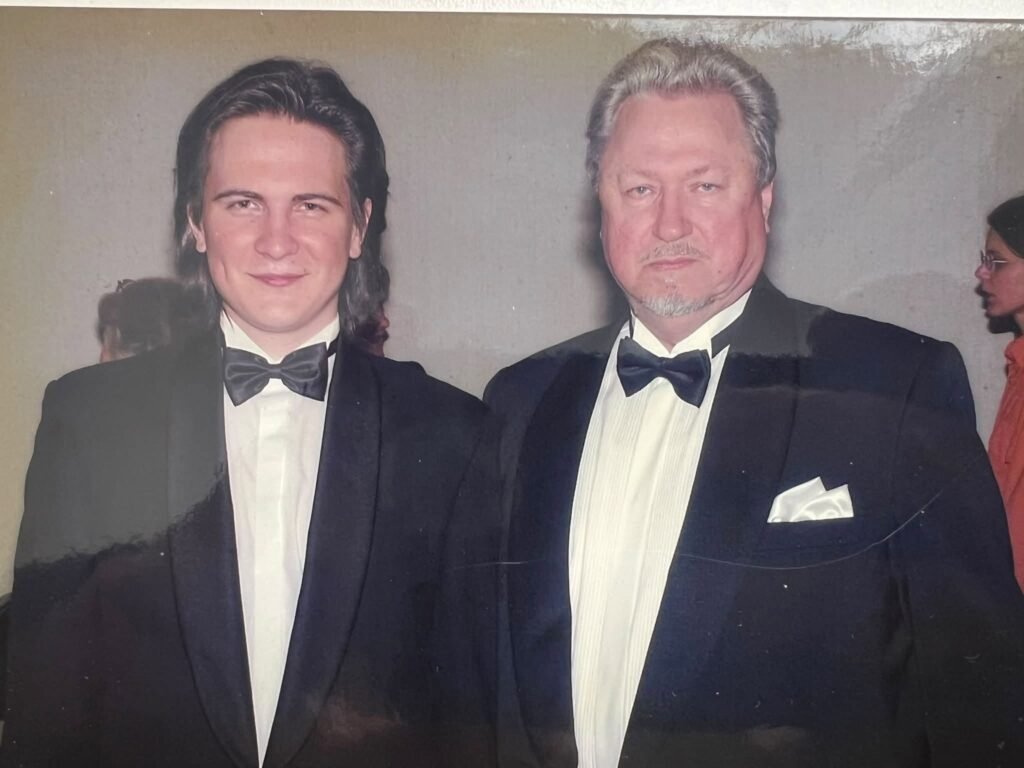
Learning from a legend is not only a privilege but also a great responsibility. Virgilijus Noreika was a teacher who shaped not just the voice, but one’s attitude to the profession, to the stage and to musical culture. My path crossed with the maestro’s much earlier. I remember my first audition, at sixteen, as if it were today. I sang a few pieces, and as he handed me his business card he said something I will never forget: “Eugenijus, singing will be your bread and butter. Call me and we’ll arrange lessons.” After those words I couldn’t sleep for several nights. I was simply enthralled – a young schoolboy suddenly hearing such confidence from a legend! It felt as though I could touch my dream.Our collaboration lasted almost a decade. I formally studied with Noreika for eight years – from the preparatory course that began in 2001, through my bachelor’s and master’s degrees. Even before my studies, I took private lessons at his studio, and after it closed, at his home. I am endlessly grateful to him. He introduced me not only to vocal mastery but to the stage in the broadest sense – how to prepare a repertoire, how to build a concert programme, how to connect with an audience, how to feel at home on stage. My musical taste and my feel for cantilena took shape under him. I still remember his lessons.
I have had quite a few teachers along the way, but there is a second very important person – Vladimiras Prudnikovas. My career as a singer falls into two very distinct stages. When I was a bass, my teacher was Noreika. Later, after I moved to baritone, I began working with Prudnikovas. I am still in touch with him, and he remains a very important authority for me. Thanks to him, I keep searching, renewing and discovering an ever more mature and free vocal sound.I am grateful to both teachers – each holds a special place on my path.
What has academic discipline given you, and what have life experiences beyond the stage given you?
Academic discipline gave me a foundation, structure, control and professionalism. Life gave me colour. Without either one, an artist would be incomplete.
You have won many competitions. What happens inside you when the results are announced?
I remember my first competition very well. I was only in my first preparatory year, while the age limit went up to third-year bachelor’s students. It was the Zenonas Paulauskas National Competition. First place went to Kostas Smoriginas, second to a soprano, and I took third. I remember the moment the results were announced. It was an incredible feeling – euphoria, joy, a kind of inner affirmation. Moments like that give you wings and motivation; they remind you why you step onto the stage and why singing becomes your path. Even now, remembering that moment gives me goosebumps. But after the euphoria, reality always follows. A long road of searching, growth and work on yourself begins.
Has a defeat ever proved more valuable than a victory?
Yes, there have definitely been times when a defeat turned out to be more valuable than a victory. I clearly remember one particularly important moment on my path. I was still a bass at the time, and I travelled to what was, in effect, my last audition as a bass – held on the main stage of La Scala in Milan. I wanted to get into the Opera Studio. I sang two pieces at the audition, which was already unusual, since most candidates sang only one. They asked me for another and listened very attentively. But the result was negative – I wasn’t accepted. When I returned to Lithuania, I went through a deep inner shock. Yet it was precisely then that a very clear realisation came – it was a turning point: I needed to change my voice type. I decided to move from bass to baritone – to my voice’s natural character. A completely new stage began: new repertoire, new vocal technique, a new understanding of myself. And today I can say that this “defeat” became one of the most important driving forces in my career. It set me on the path I am now successfully following.
Do you still feel the need to prove your worth to anyone today?
In the past, especially after my studies when I was younger, I certainly felt a strong need to prove I was worth something. That’s a natural stage – you want recognition, affirmation, a place in the profession. But over the years a different understanding has come. More and more you feel that what matters most is not proving yourself, but following your own path. Singing is not a competition for me – it is my calling, my way of life. Today, rather than proving something to someone, I want to be on stage, to be in the music, to create roles I haven’t yet performed, and to reveal myself as both a singer and an actor. What matters most now is being true to myself and enjoying what I do.
Onegin, Figaro, Escamillo, Don Carlo – which is closest to your temperament?
Every role I have created is important. There are now more than thirty of them. I put a piece of myself into each one – my experience, my emotions, my inner states. So I wouldn’t single out any particular character. All the roles are close to me in their own way, because in each one I find something personal.
How is a role born – from the colour of the voice or from the human soul?
Always from the person. If there is no truth in the character, the colour of the voice remains just a beautiful sound.
Does a character ever take a while to “let you go”?
Yes, and it’s a beautiful, though sometimes difficult, process. Some roles live on inside me for a long time.
Which role was the greatest inner challenge?
In terms of vocal challenges, one of the most difficult was Don Carlo in Verdi’s Ernani. It’s a part that demands enormous technical control and stamina. But my greatest inner, emotional challenge was the role of Macbeth. It required complete openness, both vocally and emotionally.
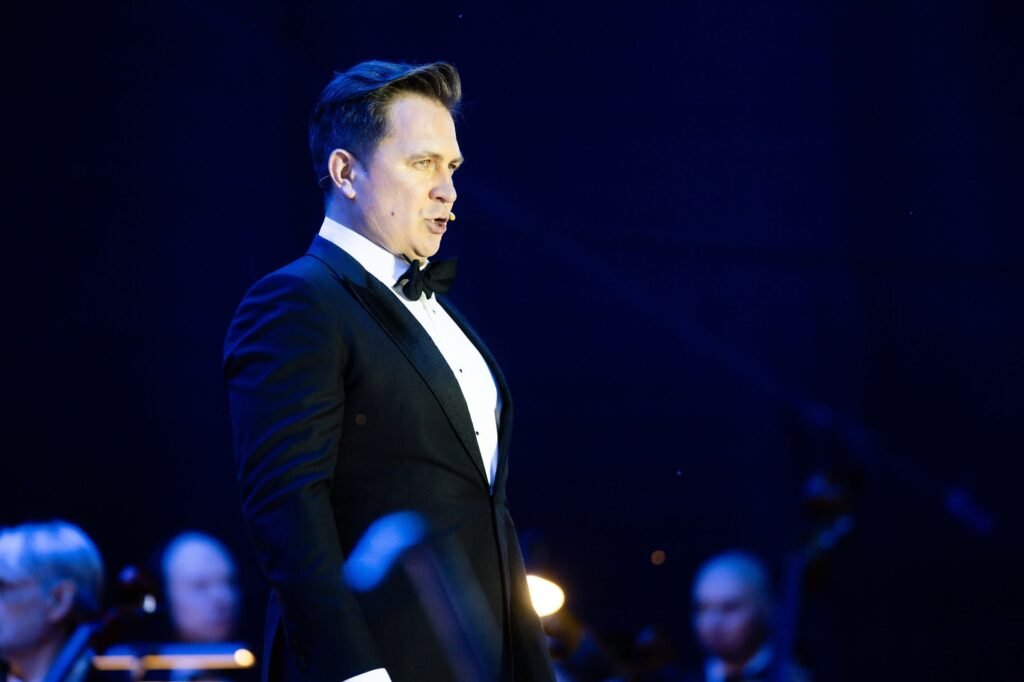
The voice is an invisible instrument. Does it ever betray you?
The voice is very sensitive. It never betrays you without a reason. Most often, it simply reminds you of the importance of balance.
How do you protect silence?
Silence is essential for me. It is the space where not only the voice but also the inner self is restored.
When the hall empties, what remains for you?
When the hall empties, I am left with gratitude and a sense of peace. And at the same time – joy, euphoria, adrenaline, motivation. The applause still rings in my mind; I see people’s happy eyes and remember their words and compliments. That’s when I understand very clearly why I do all this – for that special moment that remains after a concert. It’s a kind of exchange of energy. You give yourself on stage, and people give it back through their applause, their emotion, their energy. And that feeling stays with me for a long time.
If you had to say in one sentence why it’s worth being on stage?
For the moments when music unites people’s hearts.